Some animals survive in the wild by living on their own. Others live in flocks, packs, schools or herds. Others still, great and small, form the odd couple to survive.
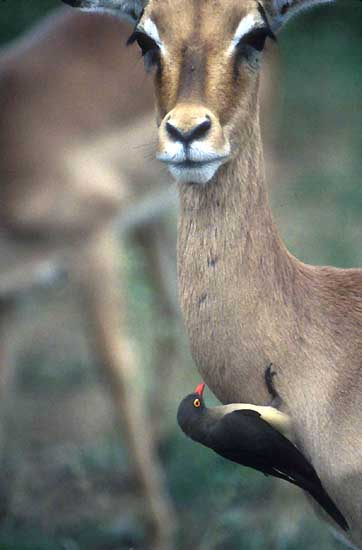
For example, if you're seeking an oxpecker, take a close look at a girafe, a zebra or an antelope. Indeed, oxpeckers forage in small flocks on large mammals to eat fleas, flies and ticks, protecting them from blood-sucking bugs. Oxpeckers will make quick scissoring movements through their host's hair with their bill and they can even reach deep in the ears or around the muzzle, eyes and nose. They are also known to consume wound tissue, blood and other secretions.
 .
.
In exchange for the cleaning service, the oxpeckers spend a good part of their lives on their hosts, using them for protection against predators. A good deal if you ask me!
Another odd couple: the plover and the crocodile. It seems that the crocodile opens its mouth wide while the plover hops right in and eats the food stuck between the crocs teeth. The plover gets a free meal and the croc, clean teeth! Some believe that their realtionship has more to do with protecting each other's nests. With the crocodiles near by, the plovers' nests are protected from predators and in return, the plovers give a warning cry when discovering lizards near by. As soon as the alert cry is out, the crocodile leaves the water to get closer to its nest.
Since the honeyguide bird can find the honey in a beehive but doesn't have access to it, it has formed a relationship with the badger. This mammal can't find the honey and relies on the call of the honeyguide bird to find it. It uses its sharp claws to rip open the hive. Once the badger has had its fill, the bird delightfully enjoys the rest of the honey.
So odd couples are needed in the wild to survive!
Posted by snackshackforbirds.com
Information taken from:
http://creagrus.home.montereybay.com

http://magma.nationalgeographic.com
http://dml.cmnh.org
http://wiki.answers.com/Q/What_is_the_relationship_between_a_Honeyguide_bird_and_Honey_badger

No comments:
Post a Comment