Sunday, June 10, 2012

WHAT ABOUT BIRDBATHS?

Why a birdbath?


We eagerly put out bird seeds to attract the birds to our yard.  Some bird lovers will even offer more than one kind of seed.  But offering water is such an important resource to give the birds, even more so in winter when open water sources can be very difficult to find.


As with birdfeeders, birdbaths require maintenance.  Birdbaths must be cleaned on a regular basis.  During warm weather, algae will inevitably form in your birdbath.  Additives and algae remover as well as different kinds of cleaners aren't necessary and may harm the birds.  All you need is water and a stiff brush to remove the algae.  


Often fill the birdbath with fresh water...remember, birds drink and bathe in the same water!


A lot of people buy deep birdbaths hoping that they won't have to refill it as often.  But birds seem to prefer those that are fairly shallow.  Also, they like a bath with some texture to it in order to get a better grip and avoid slipping.


Birdbaths may be placed on the ground to avoid being tipped over. But the main reason is that birds are used to drinking from puddles, ponds...


Why not try a heated birdbath during the winter months?  It is one of the best ways to attract birds during this cold season.  Not only will more birds come to visit, but a greater variety of them will show up!


To sum it up:

  • regularly fill birdbaths with fresh, clean water
  • wash often, simply with water and a stiff brush
  • choose a birdbath that is fairly shallow and has a rough texture on the inside

Posted by snackshackforbirds.com

Information taken from "Why Don't Woodpeckers Get Headaches?" - Mark O'Conner

Sunday, June 3, 2012

SURVIVING AS AN ODD COUPLE


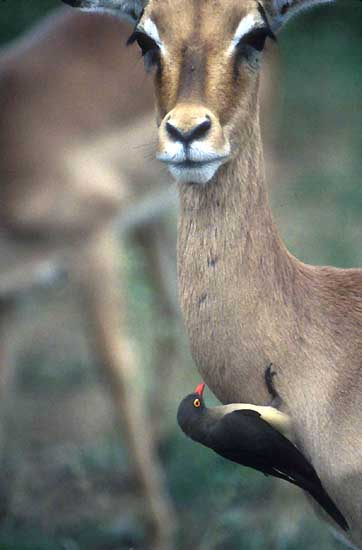
Some animals survive in the wild by living on their own. Others live in flocks, packs, schools or herds.  Others still, great and small, form the odd couple to survive.


For example, if you're seeking an oxpecker, take a close look at a girafe, a zebra or an antelope.  Indeed, oxpeckers forage in small flocks on large mammals to eat fleas, flies and ticks, protecting them from blood-sucking bugs. Oxpeckers will make quick scissoring movements through their host's hair with their bill and they can even reach deep in the ears or around the muzzle, eyes and nose. They are also known to consume wound tissue, blood and other secretions.  


.


In exchange for the cleaning service, the oxpeckers spend a good part of their lives on their hosts, using them for protection against predators.  A good deal if you ask me!


Another odd couple: the plover and the crocodile.  It seems that the crocodile opens its mouth wide while the plover hops right in and eats the food stuck between the crocs teeth.  The plover gets a free meal and the croc, clean teeth!  Some believe that their realtionship has more to do with protecting each other's nests.  With the crocodiles near by, the plovers' nests are protected from predators and in return, the plovers give a warning cry when discovering lizards near by.  As soon as the alert cry is out, the crocodile leaves the water to get closer to its nest.


Since the honeyguide bird can find the honey in a beehive but doesn't have access to it, it has formed a relationship with the badger.  This mammal can't find the honey and relies on the call of the honeyguide bird to find it.  It uses its sharp claws to rip open the hive.  Once the badger has had its fill, the bird delightfully enjoys the rest of the honey.


So odd couples are needed in the wild to survive!


Posted by snackshackforbirds.com


Information taken from:

http://creagrus.home.montereybay.com

http://magma.nationalgeographic.com
http://dml.cmnh.org
http://wiki.answers.com/Q/What_is_the_relationship_between_a_Honeyguide_bird_and_Honey_badger