Tuesday, October 9, 2012

Learn to relax...


Relax...there's a word that's been negleted.  Yet, nature has so much to offer to do just this!  Personally, I love waking up to the songs of the chickadees or tits.  Crows just don't do it for me!

How can one not relax while watching our featherd friends feed at a decorative birdfeeder or splash in a glass birdbath?


I mean, you can add charm and beauty to your yard by placing a beautiful statue that also serves to let the birds rest and bathe.  There are so many bird products out there that will attract birds to your home!


Though I'm not a big fan of crows - these are very intelligent birds mind you! - I love watching them trying to get at the suet that I hang year-round.  These guys are big birds so it takes fanciful steps for them to actually reach it.  It's trial and error but they manage to grab on to it and sometimes leave with the whole thing. Hmm, back to the store again.

Nonetheless, watching these lovely creatures through all seasons is a blessing.  And yes, it does relax me.  To sit and just observe their doing-abouts is living the moment.  The present moment.  It is being mindfull.  Now, there's something I'm working on and my feathered friends are helping through...one song at a time!

posted by: snackshackforbirds.com

Monday, September 17, 2012

HANGING BIRDHOUSES


Different types of birds are attracted to different kinds of birdhouses. Wrens and finches are one of the only species that tolerate a swinging nest box.  Chickadees and Tree Swallows will use them on occasion.


The hanging/swinging bird houses are to be suspended ideally from a tree branch. Houses that are hung from a tree give a feeling of comfort and security to the birds. Be careful though that the hanging birdhouse is located in a place which is safe from predators like raccoons, snakes, opossums, fire ants, cats and so on. Proper location of your hanging birdhouse will attract birds to inhabit it.

Birds that are comfortable in a swinging birdhouse prefer an open field or a large backyard that does not have much vegetation.  If you listen closely, you may hear the mothers singing a lullaby while swinging their little ones to sleep...


Posted by snackshackforbirds.com
Inspired by petcaregt.com

Thursday, July 26, 2012

BIRDHOUSES FOR PURPLE MARTINS...which ones?


     Because Purple Martins are social birds that live in colonies, Multiple-room birdhouses are a great choice for these swallows.  These houses start from 6 rooms and can go up to 24 rooms.  There are a few things to consider when buying a multiple-room birdhouse.


     There are a variety of styles to choose from: hexagonal, convertible or even a replica of the Hotel California !  Have fun choosing the one that will best suit your yard.  These houses can range in price from less than $100 to much more, so you can follow your budget.    


      You might like to consider from which material it is made of.  Purple martin birdhouses are usually lightweight and can be made of aluminum, plastic or wood.  Which one you'll choose really depends on what you prefer.  The plastic ones are amongst the least expensive and are lightweight.  As for the aluminum birdhouses, they are also lightweight, durable and easy to clean. The wooden ones have a more traditional look to them.  The important factor to take in is the easy-cleaning aspect of the birdhouse.  Purple Martin birdhouses should be cleaned at the end of the nesting season.

     Consider these tips to attract purple martins to your yard:
  • Martin houses are best hung between 10 to 20 feet off the ground ( remember that they have to be cleaned!!)
  • To keep predators at bay, be sure that the martin house is a safe distance from vines, bushes and small trees; open area of about 30 feet away from trees or structures
  • Place the house near permanent water sources (ponds, lakes, streams)
  • The entrance hole shoud be one inch above the floor; too high makes it harder for the martins to enter and exit; too low makes it easier for predators or bad weather to find their way in!
  • Be sure the entrance hole is between 1 3/4 to 2 1/4 inches, the most popular being 2 1/8 inches.


Sunday, June 10, 2012

WHAT ABOUT BIRDBATHS?

Why a birdbath?


We eagerly put out bird seeds to attract the birds to our yard.  Some bird lovers will even offer more than one kind of seed.  But offering water is such an important resource to give the birds, even more so in winter when open water sources can be very difficult to find.


As with birdfeeders, birdbaths require maintenance.  Birdbaths must be cleaned on a regular basis.  During warm weather, algae will inevitably form in your birdbath.  Additives and algae remover as well as different kinds of cleaners aren't necessary and may harm the birds.  All you need is water and a stiff brush to remove the algae.  


Often fill the birdbath with fresh water...remember, birds drink and bathe in the same water!


A lot of people buy deep birdbaths hoping that they won't have to refill it as often.  But birds seem to prefer those that are fairly shallow.  Also, they like a bath with some texture to it in order to get a better grip and avoid slipping.


Birdbaths may be placed on the ground to avoid being tipped over. But the main reason is that birds are used to drinking from puddles, ponds...


Why not try a heated birdbath during the winter months?  It is one of the best ways to attract birds during this cold season.  Not only will more birds come to visit, but a greater variety of them will show up!


To sum it up:

  • regularly fill birdbaths with fresh, clean water
  • wash often, simply with water and a stiff brush
  • choose a birdbath that is fairly shallow and has a rough texture on the inside

Posted by snackshackforbirds.com

Information taken from "Why Don't Woodpeckers Get Headaches?" - Mark O'Conner

Sunday, June 3, 2012

SURVIVING AS AN ODD COUPLE


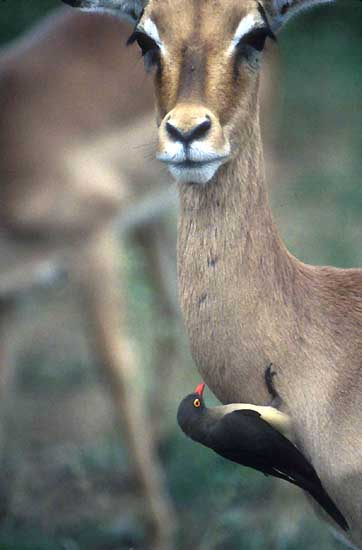
Some animals survive in the wild by living on their own. Others live in flocks, packs, schools or herds.  Others still, great and small, form the odd couple to survive.


For example, if you're seeking an oxpecker, take a close look at a girafe, a zebra or an antelope.  Indeed, oxpeckers forage in small flocks on large mammals to eat fleas, flies and ticks, protecting them from blood-sucking bugs. Oxpeckers will make quick scissoring movements through their host's hair with their bill and they can even reach deep in the ears or around the muzzle, eyes and nose. They are also known to consume wound tissue, blood and other secretions.  


.


In exchange for the cleaning service, the oxpeckers spend a good part of their lives on their hosts, using them for protection against predators.  A good deal if you ask me!


Another odd couple: the plover and the crocodile.  It seems that the crocodile opens its mouth wide while the plover hops right in and eats the food stuck between the crocs teeth.  The plover gets a free meal and the croc, clean teeth!  Some believe that their realtionship has more to do with protecting each other's nests.  With the crocodiles near by, the plovers' nests are protected from predators and in return, the plovers give a warning cry when discovering lizards near by.  As soon as the alert cry is out, the crocodile leaves the water to get closer to its nest.


Since the honeyguide bird can find the honey in a beehive but doesn't have access to it, it has formed a relationship with the badger.  This mammal can't find the honey and relies on the call of the honeyguide bird to find it.  It uses its sharp claws to rip open the hive.  Once the badger has had its fill, the bird delightfully enjoys the rest of the honey.


So odd couples are needed in the wild to survive!


Posted by snackshackforbirds.com


Information taken from:

http://creagrus.home.montereybay.com

http://magma.nationalgeographic.com
http://dml.cmnh.org
http://wiki.answers.com/Q/What_is_the_relationship_between_a_Honeyguide_bird_and_Honey_badger

Monday, May 14, 2012

CROWS ARE SMARTER THAN YOU THINK...

Crows are amongst the smartest in the avian world.  So, "birdbrain" really isn't insulting for them.  In fact, their brain is relatively the same size as the chimpanzee brain.  As do apes, crows think about their physical and social environment.  Crows have been seen building tools to help probe for food; one way is by crafting hooks with twigs in order to poke holes in trees and another is to shape stiff leaves into sharp tools, with their beaks,  to be able to probe rubbish leaves for insects.

A stunning discovery they made is how to crack open tough nuts.  They will patiently wait at a traffic light crossing, waiting for the red light and walk along with the human pedestrians to finally reach their reward: a cracked nut, thanks to road traffic!! (Watch "Crows Using Traffic To Crack Walnuts" )

Crows also like to have fun.  This one was filmed sliding down a roof more than once. and when it couldn't slide, it would peck at its very own "crazy carpet" to make it go a bit further. To catch a glimpse of this amazing scene, go to You Tube and watch "Crow Goes Sledding".

I believe we have yet to discover how very smart these birds are!!

Posted by snackshackforbirds.com


with help from:  news.nationalgeographic.com

Sunday, April 22, 2012

WOODPECKERS WITHOUT HEADACHES

How do woodpeckers manage to literally hammer their heads into trees 20 times per second with a force of 15 mph?  We can't even hammer a nail that fast!!  They drill holes in trees for their nests and to hunt insects or drum on the trunks to signal other woodpeckers.  That means at the end of the day, they drilled and drummed about 12 000 times...and I don't hear them complaining about headaches!


These birds can handle it because their bodies are designed to absorb the impact.  Dense muscles, sponge-like bones and a third eyelid keep their brains - and eyes -  intact. Let's take a closer look...

Even before the beak hits the tree straight on ( a millisecond), the thick muscles in the back of the neck contract.  Because of this reflect, some of the force radiates down these muscles therefore protecting the brain from a full blow.  Let's not forget the sponge-like bones that act like a cushion.

Another reason a woodpecker's brain is so well protected is because of its rigidity. Since their brains don't bathe in any spinal fluid, it doesn't bounce around with each impact.  In fact, their brains are attached firmly to their skulls.

Also in that millisecond before the bill strikes the wood, a thick membrane closes over the bird's eyes, shielding them from any pieces of wood bouncing off the tree.  The thick inner eyelid serves to keep the eyeballs in place, holding them back against the strong impact.  As for the outter lid, it is rich in blood vessels, keeping the retina from being jostled around.

Other interesting facts:
- the nostrils are slit-like and covered with feathers protecting them from splinters and sawdust
- the woodpeckers are able to "hold on tight" when they drill thanks to their four-clawed toes (2 pointing forward and 2 backward) and their stiff tails

posted by snackshackforbirds.com

paraphased http://www.msnbc.msn.com  "Why Don't Woodpeckers Get Headaches?"

Sunday, March 18, 2012

WHAT'S FOR DINNER?

That depends on who you want to invite.  Here's a list that will help you prepare the menu for your feathered guests.

First of all, no matter who your guests are, birds need fresh water.  Very cold or dry weather may be when water is needed the most.  Birds love to bathe and people love to watch them.  Even the sound of running water will attract birds. And bathing birds attract people!

What to put on the plate - so to speak...

Sunflower seeds are a favorite for Finches, Cardinals, Blue Jays, Scrub Jays, Chickadees, Nuthatches, Titmice, Mourning Doves, Buntings, Grosbeaks, Juncos and Sparrows.  Black oil sunflower seeds are a high quality feed for them since these seeds are a high energy and nutritious food source packed with protein and fat and leave less waste than some other seeds. 

Another highly nutritious seed rich in protein and fat are the thistle seeds or Nyjer.  Goldfinches, House Finches, Purple Finches, Redpolls, Siskins, Juncos, and even Mourning Doves eat thistle seeds. Nyjer Feeders with tiny openings limit which birds can feed and it seems that squirrels don't like thistle (nyjer).

Suet (animal fat) and Peanut Butter, rich in proteins and fat, provide needed energy for wintering birds like Woodpeckers, Nuthatches, Chickadees and Titmice.  To this list, add Mourning Doves, Sparrows and House Finches that will eat peanut butter. Most birds will eat some suet.  You can make your own by mixing animal fat or vegetable oil with bird feed, peanut butter and fruit.  Since the fat tends to become rancid in warm weather, feed it in winter. For warmer weather, skip the fat and oil and just use peanut butter.

Shelled Peanuts and Whole Peanuts in the shell are highly nutritious for the birds that can eat them.  **Always use unsalted nuts.  Bluejays, Scrub Jays, House Finches, Cardinals, Woodpeckers, Magpies, Chickadees, Nuthatches, Titmice, White-crowned and White-throated Sparrows eat peanuts. Take note that squirrels love peanuts too.

Cardinals, Mourning Doves, Finches, Grosbeaks, Jays, Chickadees, Nuthatches, Titmice, Song Sparrows, and White-throated Sparrows enjoy Safflower seeds, also rich in protein and fat.

Another popular mixed blend filler is Millet.  The white variety is prefered by House Finches, Mourning Doves, Cardinals, Buntings, Juncos, Towhees, Blackbirds, Pigeons, Song Sparrows, White-crowned and White-throated Sparrows, as well as English Sparrows.

Corn is enjoyed by Bluejays, Mourning Doves, Juncos, Blackbirds and Sparrows. It is a particular favorite for  Pheasants, Turkeys, Partridge and Grouse. *Take note that Pigeons, Starlings, cowbirds and squirrels also like corn.

Migrating birds and early arrivals regularly encounter shortages of their usual feeding sources so make sure fruit is made available for them. Add dried blueberries and dried cranberries to increase the variety of birds in your yard.  Cardinals, robins, orioles, thrashers, catbirds, waxwings, warblers, tanagers, and flickers will eat these dried fruit. Oranges are also enjoyed by some, especially the Orioles.

Let's not forget our beautiful friends, the hummingbirds. There are many Nectar producing plants for hummingbirds.  Here are a few: Trumpet Honeysuckle, Trumpet Vines, Honeysuckle, Monarda, Coral Bells, Salvia, Fuchsia, Petunia, Corydalis, Impatiens, Firecracker, Lillies, Belladonnas,  Hibiscus, Lantanna, Snapdragon, Ivy Geraniums, Cigar Plant, Quince...and the list goes on. Though red seems to be the color that attracts them the most, try other colored flowers too.  Plant large, thick gardens or simply plant nectar producing flowers in window boxes and view them from up close.  Keep in mind that hummingbirds visit a lot of flowers to get a little nectar.  Here's an interesting fact: Hummingbirds also eat insects visiting and living in the plants and even make nests from spider webs.   

If you're lucky, you may even get birds to eat from your hand.  If you place feed in a cup formed by your palm upturned and fingers pointing up for a perch, you may see Chickadees, Red-breasted Nuthatches, White-breasted Nuthatches, Tufted Titmice, Bluebirds, Evening Grosbeaks, Redpolls, Jays, and Chipping Sparrows.  Since birds see well from a distance, they will easily notice you are holding feed.

Enjoy planning the menu and watch the birds enjoy their meal!!

Information taken from www.50birds.com

Wednesday, March 7, 2012

Purple Martins


Purple Martins

  • Purple Martin The Purple Martin is the largest of the North American swallows.
  • It can be distinguished from other swallows by its large head, thick chest and broad, pointed wings.  No other swallow has a dark belly. In fact, the adult male Martin is entirely bluish-black.  As for the female, she has a bluish-black back with a dingy grey-brown chest and a paler dirty grey belly.  She also has a grey collar around the back of the neck.
  • In eastern North America, the Purple Martin has nested almost exclusively in nest boxes for more than 100 years. Among birds that use nest boxes, this song bird is unusual in that several pairs will nest in a single box with multiple compartments. However, one male will attempt to defend multiple compartments.
  • The Purple Martin not only gets all its food in flight, it gets all its water that way too.  It skims the surface of a pond and scoops up the water with its lower bill.
  • It breeds especially near water and large open areas but can also breed in saguaro cactus, and in western montane forests around beaver ponds.
  • The Purple Martin clutch size is 1-8 eggs.  Egg color is white.  Incubation period is 15-18 days.  Chicks fledge in 28-29 days.
  • Posted by: snackshackforbirds.com

Sunday, February 26, 2012

Eastern Bluebirds


  • The male Eastern Bluebird is a brilliant royal blue on the back and head and warm red-brown on the breast. Blue tinges in the wings and tail give the greyer females an elegant look.
  • Eastern Bluebirds can be found in open country with patchy vegetations and large trees, meadows, old fields or golf courses. Bluebirds typically sit in the open on power lines or along fences.
  • They don't often visit backyard feeders but they will use nest boxes put up in your yard, if they aren't too hemmed in by trees or houses.
  • Insects caught on the ground are a bluebird's typical meal though major prey include caterpillars, beetles, crickets, grasshoppers and spiders. During the fall and winter seasons, bluebirds eat large amounts of fruit including mistletoe, sumac, blueberries, black cherries, tupelo, currants, wild holly, dogwood berries, hackberries, honeysuckle, bay, pokeweed and juniper berries. Though rare, Eastern Bluebirds have been recorded to eat larger prey such as salamanders, shrews, snakes, lizards and tree frogs.
  • The male Eastern Bluebird displays at its nest cavity to attract a female. He brings nest material to the hole, enters and exits it, and waves its wings, staying perched above the cavity. That's pretty much its contribution to nest building. The female eastern bluebird is the one that buils the nest and incubates the eggs.
  • Eastern Bluebirds typically have 1-3 successful broods per year; clutch size can be 2-7 pale blue eggs. Early nests usually leave their parents in summer, but young from later nests frequently stay with their parents through the winter season.
  • Average lifespan in the wild is 6-10 years; the oldest recorded Eastern Bluebird was 10 years, 5 months old.
  • Bluebirds are considered fairly common these days, but their number had declined significantly during the last century. Thanks to nest boxes that are now seen in parks and backyards, their populations have been given a boost.


Post brought to you by snackshackforbirds.com


Information paraphrased from allaboutbirds.org

Tuesday, February 14, 2012

There are many types of birdfeeders out there.  Some are for seeds, some for suet or peanuts and some for sugar solutions.  Therefore, different types of feeders attract different types of birds.  You may place a tray feeder on the ground to attract jays, blackbirds and sparrows.  The hopper feeder, which holds a large amount of seeds, will attract hopper birds such as jays, sparrows,chickadees, cardinals and titmice.  The cylinder-shaped tube feeder will let you attract small or larger birds depending on the size of the perches.  If you wish to attract small song birds, such as chickadees or Goldfinches, hang a thistle feeder.  The openings are very small to dispense tiny thistle seeds.  As for suet feeders, mesh cages in which you put a suet cake, these are favorites of woodpeckers, nuthatches, chickadees jays and titmice.  The sugar solution poured into the hummingbird feeder will be sure to attract hummingbirds.

Important tips: 
  • Use birdfeeders instead of just spreading seeds on the ground in order to avoid attracting pests.
  • Place feeders close enough to branches or shrubs to allow cover for the birds yet not so close to them so that squirrels may launch for an easy meal.
  • Add fine sand to seeds to help birds with their digestion
  • Place feeders either very close to your windows or far away enough so that they won't hit into the windows full speed while flying away from feeders.
  • ALWAYS clean your feeders at least once every two weeks using hot, soapy water - trays may be cleaned more often since birds stand in them.  You don't want birds getting sick because of accumulated moldy seeds.

   One last tip to attract our feathered friends to your home:  Add a birdhouse or a birdbath near the feeders.  The birds will take advantage!!


Information gathered from http://www.easybackyardbirding.com

Posted by Michelle at 13:34